


 En
 English
 русский
 Español
 عربى

Why Heavy-Duty Traction Freight Elevators Need Reinforced Car Floors and Door Shoes
Posted by Admin | 05 Nov
Content
- 1 What Makes a Freight Elevator Heavy Duty
- 2 Why Reinforced Car Floors Are Non-Negotiable
- 3 Durable Door Shoes: Small Parts, Heavy Consequences
- 4 Traction Drives Raise the Stakes
- 5 Engineering Practices That Extend Service Life
- 6 Frequently Asked Questions
- 6.0.1 Q1: Why must freight elevator floors be reinforced even if the rated load is the same as a passenger elevator?
- 6.0.2 Q2: How often should door shoes be replaced on a heavy-duty freight elevator?
- 6.0.3 Q3: Can a passenger elevator car be converted into a freight elevator by strengthening the floor?
- 6.0.4 Q4: What is the best material for freight elevator door shoes?
Heavy-duty traction freight elevators are not passenger elevators with a larger nameplate. They are industrial material-handling systems that run constantly, carry dense loads, and absorb impacts that would never occur in an office tower. Under these conditions, the car floor and the door shoes become the two most failure-prone structural points if they are not engineered correctly. This article explains why reinforced car floors and durable door shoes are decisive for the long-term performance of heavy-duty traction freight elevators.
What Makes a Freight Elevator Heavy Duty
A heavy-duty freight elevator is defined by far more than a large rated load. Its duty cycle, the type of cargo-handling equipment used inside the car, and the operating environment together determine the mechanical stress acting on every major component.
A passenger elevator carries distributed foot traffic. A freight elevator, by contrast, carries pallet jacks, forklifts, roll cages, and conveyor-fed loads. These vehicles place the payload on a very small contact area: a pair of polyurethane wheels or a steel fork. The resulting point load is several times higher than the average pressure generated by a uniform load.
| Parameter | Passenger Elevator | Heavy-Duty Freight Elevator |
|---|---|---|
| Rated load | 630-1,600 kg | 1,000-10,000 kg |
| Load application | Distributed foot traffic | Point loads from wheels and forks |
| Starts per hour | 60-90 | 120-240 |
| Door cycles per day | 200-500 | 1,000-3,000 |
| Operating environment | Clean and climate-controlled | Dusty, humid and industrial |
The table highlights why freight elevators cannot be built to passenger standards. Every parameter, from load application to door cycles, places additional stress on the car floor and the door system. Designers who ignore these differences produce elevators that fail prematurely and force costly downtime.
Why Reinforced Car Floors Are Non-Negotiable
The car floor is the load-bearing interface between the payload and the entire elevator structure. When a heavy load rolls into the car, the floor must not simply hold the weight; it must spread the load across the car frame and guide system without excessive deflection. A reinforced floor achieves this with a thicker steel base plate, closely spaced cross-members, and continuous welded seams instead of light-gauge spot welding.
The need for reinforcement goes far beyond protecting the floor sheet. If the floor flexes when a forklift drives in, the car frame twists slightly under the asymmetric load. That twist changes the alignment of the car guide shoes, adds uneven pressure to the guide rails, and shifts the door sill relative to the landing door frame. The immediate consequences are accelerated door shoe wear, erratic door operation, and premature wear of the guide system.
Reinforced floors are also matched to the environment. Hot-rolled chequered steel plate is the standard choice for general cargo because it resists slipping and tolerates impact. In food and pharmaceutical facilities that require frequent washdown, AISI 304 hairline stainless steel offers corrosion resistance and easy cleaning. For logistics centers with severe point loads, a steel load-bearing structure is often combined with a replaceable wear layer that can be renewed before the main floor is damaged.
Because every freight application is different, floor reinforcement must be based on a real load audit rather than a generic drawing. The heaviest wheel loads, the footprint of the largest pallet, and the number of daily cycles should all be design inputs. Customized elevator design allows your car structure to be matched to the exact material-handling fleet used on site.
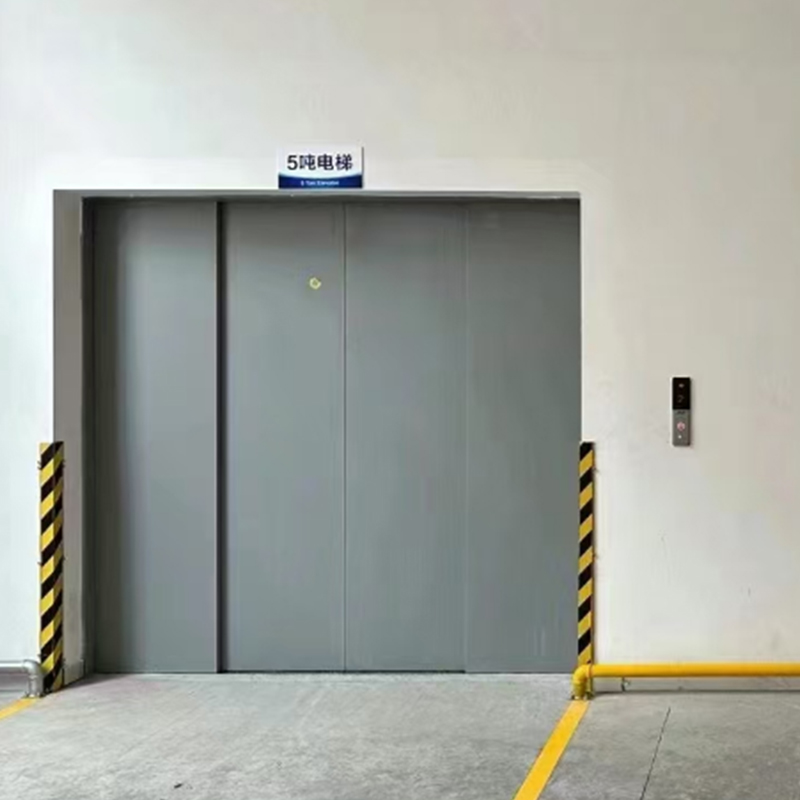 Traction Freight Elevator with Customizable Load and SpeedThis traction freight elevator supports 450–2000 kg loads and speeds up to 7 m/s, with durable stainless steel construction. Its customizable design suits site-specific heavy-duty cargo needs.View Product →
Durable Door Shoes: Small Parts, Heavy Consequences
Elevator door shoes are the small sliding elements fixed to the bottom of each door panel. They ride in a guide groove in the door sill and keep the door straight as the operator moves it. On the car door, the shoe also positions the door vane, which must enter the landing door mechanism to release the interlock. When the vane is even slightly off center, the elevator will not run.
Freight elevator doors work under conditions that would quickly destroy passenger-grade shoes. The doors themselves are larger and heavier, often clad with thick stainless-steel panels. The sill collects dust, sand, metal chips, and debris from pallets and forklift tires. The elevator runs constantly, and the same segment of sill is passed hundreds of times per shift. The result is a wear groove that concentrates over a narrow area of the shoe.
Durable freight-grade door shoes are manufactured from self-lubricating polymers such as reinforced nylon or polyurethane, frequently with a metal core for rigidity. These materials resist abrasive wear, maintain consistent friction, and can be adjusted or replaced without dismantling the door panel. A well-designed shoe keeps a clearance of roughly 0.5 to 2 mm over the sill and holds the vane position within the tight tolerances required by modern interlock systems.
Traction Drives Raise the Stakes
Heavy-duty freight elevators are increasingly driven by traction systems rather than hydraulic power. A traction elevator moves the car with steel ropes or belts over an electric motor-driven sheave, and a counterweight balances a large percentage of the car weight. Because the motor only overcomes the weight imbalance, the system moves heavy loads efficiently across many floors, making it the preferred choice for warehouses and manufacturing plants.
That efficiency, however, comes with a more demanding duty cycle. As we explain in our analysis of the traction drive system in commercial heavy-duty freight elevators, traction machines are designed for continuous operation under higher start frequencies than hydraulic systems can sustain. Every extra running hour means more door cycles, more passes over the sill, and more accumulated fatigue in the car floor. The counterweight balances the static weight, but it does not reduce the dynamic point loads on the floor or the friction on the door shoes.
This is the core insight: reinforcement is not an option for traction freight elevators. It is a direct consequence of how they are used. Each additional cycle, each heavier pallet, and each faster trip increases the demand on the floor structure and the entrance system.
Engineering Practices That Extend Service Life
The most reliable heavy-duty traction freight elevators are engineered from the start for the physical reality of freight handling. The following practices consistently separate a durable installation from a recurring maintenance problem.
- Specify floor capacity by point load, not by rated load. The heaviest wheel or fork contact pressure must be a defined design input.
- Use finite element analysis (FEA) to optimize the floor structure before manufacturing, so cross-member pitch and plate thickness match the real duty.
- Select door shoes from wear-resistant, self-lubricating materials with a replaceable wear element.
- Provide adequate door sill protection; many operators install a replaceable stainless-steel sill cover to preserve the guide groove.
- Schedule regular door shoe clearance checks and sill cleaning. A 15-minute weekly inspection prevents costly unscheduled downtime.
| Maintenance Item | Recommended Frequency | Typical Action |
|---|---|---|
| Door shoe clearance check | Monthly | Adjust clearance to 0.5-2 mm |
| Door sill groove cleaning | Weekly | Remove dust and debris |
| Floor wear plate inspection | Quarterly | Check for dents and local deflection |
| Floor and shoe fastener torque | Semi-annually | Re-torque fixings to specification |
Frequently Asked Questions
Q1: Why must freight elevator floors be reinforced even if the rated load is the same as a passenger elevator?
The rated load is only an average limit. Freight elevators carry concentrated loads on wheels and forks that create pressure several times higher than a uniformly distributed passenger load. Reinforcement prevents the floor from deflecting under those concentrated forces.
Q2: How often should door shoes be replaced on a heavy-duty freight elevator?
It depends on duty intensity. A high-usage lift with over 1,000 door cycles per day may need new shoes every 6 to 12 months, while a moderate-duty installation can last several years. Regular clearance measurement determines the exact interval.
Q3: Can a passenger elevator car be converted into a freight elevator by strengthening the floor?
Rarely. The entire car frame, guide rails, guide shoes, and door system must also withstand the concentrated loads and the higher duty cycle. A safe heavy-duty freight elevator is designed as a system, not reinforced in a single component.
Q4: What is the best material for freight elevator door shoes?
For most industrial environments, a self-lubricating polymer such as reinforced nylon or polyurethane with a metal core offers the best balance of low friction, abrasion resistance, and dimensional stability.
Heavy-duty traction freight elevators earn their name because they absorb controlled abuse: heavy wheels, hard impacts, dusty sills, and relentless door cycles. Reinforced car floors and durable door shoes are the two elements that allow the elevator to absorb this abuse without becoming a bottleneck. When both are designed around the actual duty, the elevator becomes a dependable asset in any logistics, manufacturing, or distribution operation.

-
 Founding Road, Qidu Linhu Economic Zone, Wujiang City, Jiangsu Province, China
-
 [email protected]
-
 +86 15301576876/+86 0512-63818375
QR CODE

