


 En
 English
 русский
 Español
 عربى

Traction Freight Elevator Load Capacities and Door Sizes: A Complete Guide
Posted by Admin | 19 Oct
Content
- 1 Standard Load Capacities for Traction Freight Elevators
- 2 Standard Door Sizes for Traction Freight Elevators
- 3 What Influences Load Capacity and Door Size Selection?
- 4 Traction Drive Considerations for Freight Elevators
- 5 Frequently Asked Questions
- 6 Planning Your Traction Freight Elevator Specification
Traction freight elevators move materials in warehouses, factories, distribution centers, and commercial buildings. Unlike hydraulic freight elevators, traction systems use a motor-driven sheave and counterweight, allowing taller travel, faster speeds, and more energy-efficient operation. When specifying a traction freight elevator, two numbers matter most: load capacity and door size. This guide reviews the standard ranges and explains how to match them to your building and cargo.
These figures are only starting points. The right specification depends on pallet dimensions, forklift access, building codes, and the frequency of loading.
Standard Load Capacities for Traction Freight Elevators
Freight elevator load capacities are usually defined as the rated load the elevator system can safely carry. In traction freight elevators, the counterweight, traction machine, ropes or belts, guide rails, and car frame are all designed around this number. Standard capacities often start around 2,500 lb and extend beyond 10,000 lb. In metric units, common values are 1,000 kg, 1,600 kg, 2,000 kg, 3,000 kg, and 5,000 kg because these match standard industrial pallet loads. A typical workhorse traction freight elevator has a 6 ft wide by 8 ft deep cab and a capacity between 4,000 and 6,000 lb.
| Rated Capacity | Typical Car Size | Example Application |
|---|---|---|
| 2,500-4,000 lb (1,134-1,814 kg) | 5 ft x 7 ft | Boxed goods, light pallets, hand trucks |
| 4,000-6,000 lb (1,814-2,722 kg) | 6 ft x 8 ft | Standard palletized freight and pallet jacks |
| 6,000-10,000 lb (2,722-4,536 kg) | 6 ft x 10 ft | Double-stacked pallets or heavy equipment |
| 10,000+ lb (4,536+ kg) | 8 ft x 10 ft or larger | Machinery, large containers, industrial tools |
When the rated capacity exceeds 10,000 lb, the car depth, door width, and hoistway dimensions all increase. Many traction freight elevators in this class use two-speed sliding doors or vertical bi-fold doors to create a wider opening without requiring additional side space.
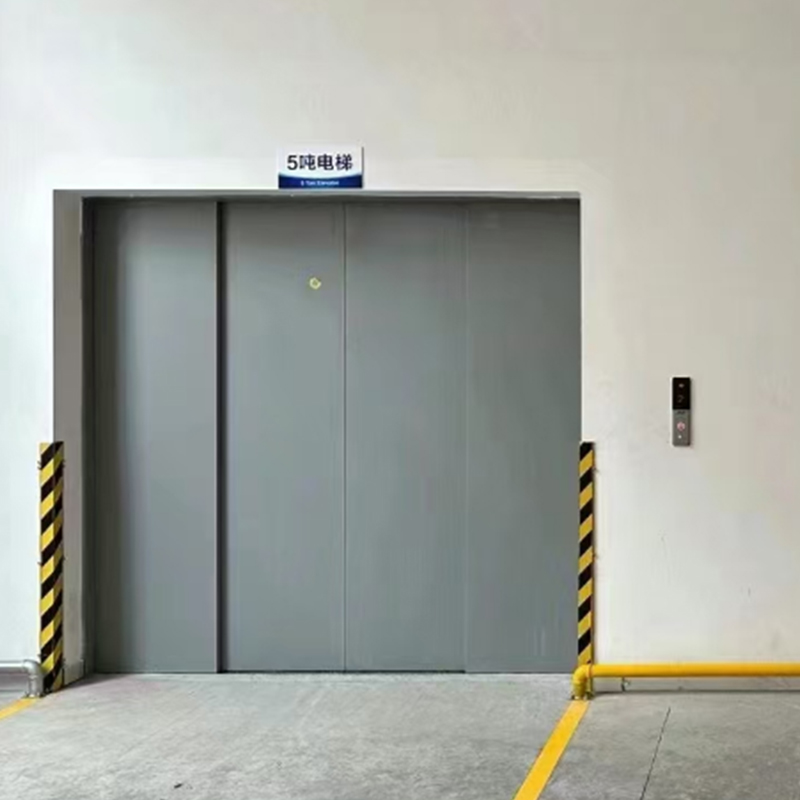 Custom Commercial Freight Elevator ManufacturersThis traction freight elevator maker provides tailored cargo lifts for heavy-duty applications, with door configurations matched to loading methods. Review it here to see how door sizing and hoistway constraints influence your selection.View Product →
Standard Door Sizes for Traction Freight Elevators
Door size determines how cargo enters the elevator. For regular freight service, the door opening is usually a few inches narrower than the car interior. Many projects use a 4 ft wide by 7 ft high door for hand truck loading and a 6 ft wide by 8 ft high door for pallet jacks or compact forklifts. The door height must also consider stacked loads, tall racks, and machine bodies.
| Door Width | Door Height | Best For |
|---|---|---|
| 4 ft (1.2 m) | 7 ft (2.1 m) | Small boxes, cartons, manual carts |
| 5 ft (1.5 m) | 7 ft (2.1 m) | Most palletized loads, one pallet at a time |
| 6 ft (1.8 m) | 8 ft (2.4 m) | Wide pallets, pallet jacks, small forklifts |
| 8 ft (2.4 m) | 8 ft (2.4 m) | Oversized equipment, roll containers, long stock |
Door width should always be coordinated with the car width. A 6 ft wide car might use a 4 ft, 5 ft, or 6 ft door, but the structural opening, door frame, and counterweight clearances must all fit within the hoistway. Traction freight elevators commonly use vertical bi-fold or two-speed doors because they allow a large opening while keeping the hoistway compact. For most mid-sized freight applications, a 6 ft wide by 8 ft high door is considered a practical standard.
Traction Freight ElevatorA traction freight elevator featuring stainless steel car finishes, LED lighting, and energy-efficient operation. Its door options and load capacities are relevant when coordinating door width with car dimensions for efficient goods flow.View Product →What Influences Load Capacity and Door Size Selection?
The correct specification is not simply the biggest possible option. It should fit the real flow of goods through the building. Common factors include:
- Pallet dimensions and the number of pallets per trip
- Forklift type, turning radius, and entry method
- Weight of the heaviest item that must be moved
- Available hoistway area and required pit and overhead clearances
- Local elevator code requirements for freight loading class
- Future changes in product size or delivery volume
If a facility moves standard 48 in x 40 in pallets, a 6 ft x 8 ft car with a 5 ft or 6 ft door is often sufficient. If the heaviest load is a 7,000 lb machine, a 6 ft x 10 ft car with 10,000 lb capacity gives more usable volume and a larger safety margin. Code requirements may also change the minimum car depth and door width based on how the elevator will be loaded by hand truck, pallet truck, or industrial truck.
Key point: Choose a load capacity first, then set the car size and door width from the largest object being moved. The door opening is part of the rated load path, so it cannot be treated as an afterthought.
Traction Drive Considerations for Freight Elevators
Traction freight elevators provide several performance advantages for buildings that need high capacity and long travel. The traction machine lifts the car through ropes or belts connected to a counterweight, which reduces motor torque and improves energy efficiency compared with hydraulic systems. This makes traction drives a good fit for tall warehouses, industrial plants, and distribution centers.
Traction freight elevator operation stability is important because cargo shifts can create uneven load distribution. The control system, guide rails, and suspension arrangement are designed to manage these forces. Machine-room-less traction designs also free up usable building space by placing the drive unit in the hoistway or on the landing, rather than in a separate machine room.
For non-standard requirements, a customized traction freight elevator can adjust car depth, door opening, rated load, door type, and control options. Custom designs are common when moving long goods, drums, heavy tooling, or automated vehicle systems. The hoistway, pit depth, and overhead height need to be confirmed by a professional survey before finalizing the specification.
Frequently Asked Questions
Q1: What is the most common load capacity for a traction freight elevator?
Answer: Many facilities select 4,000 to 6,000 lb because it matches a 6 ft x 8 ft car and accommodates standard pallet loads. Heavy-duty options with 10,000 lb or more are available for industrial production and warehousing.
Q2: What is a standard freight elevator door size?
Answer: The most common door widths are 4 ft, 5 ft, and 6 ft, with heights of 7 ft or 8 ft. A 6 ft wide by 8 ft high opening is considered a practical standard for pallet jacks and compact forklifts.
Q3: Can traction freight elevator door sizes be customized?
Answer: Yes. Manufacturers can build wider or higher doors, provided the hoistway and structural clearances allow it. Customization usually affects the door frame, door panels, and counterweight clearances.
Q4: Do I need a larger door if I use a forklift to load cargo?
Answer: Forklift entry requires extra clearance for forks, mast, and operator visibility. A 6 ft wide by 8 ft high door is often the minimum for forklift-assisted loading, and car depth must be long enough to permit safe fork entry without hitting the opposite wall.
Planning Your Traction Freight Elevator Specification
Standard load capacities and door sizes are only starting points. The final specification should be based on the heaviest and largest items you will move, the way they enter the car, and the building shaft constraints. Start with the load capacity, then define car depth and door opening. Finally, confirm pit depth, overhead, machine room or MRL space, and code requirements with the elevator supplier.
By matching the capacity and door size to the real flow of goods, you avoid paying for an oversized hoistway and prevent bottleneck problems when the elevator becomes the busiest point in your building.

-
 Founding Road, Qidu Linhu Economic Zone, Wujiang City, Jiangsu Province, China
-
 [email protected]
-
 +86 15301576876/+86 0512-63818375
QR CODE

