


 En
En English
 русский
 Español
 عربى
عربى
Traction Freight Elevator: Complete Selection Guide for Heavy-Duty Cargo Applications
Posted by Admin | 10 Sep
Content
You are fitting out a distribution hub in a 1980s concrete building. The freight lift must move 2,000 kg pallets to three floors, but the existing shaft has only a 400 mm deep pit and no machine room. The hydraulic proposal fails on both counts. A traction freight elevator is the option that meets the load requirement without the deep excavation. This guide breaks down the technical decisions behind that choice.
What Defines a Traction Freight Elevator?
A traction freight elevator is a vertical cargo transport system that uses a motor-driven sheave and steel ropes to lift a reinforced cab, relying on friction rather than oil pressure. The drive mechanism provides a mechanical advantage that lets a smaller motor move heavy loads while maintaining control of the cab's descent.
Freight cabs differ from passenger cabs in the way they are built. Floors are typically 6 mm steel with anti-slip plates, walls are reinforced with impact bars, and doors are rated for continuous pallet traffic. These details matter because a freight elevator is not a passenger lift carrying occasional boxes it is a production asset moving raw materials, pallets, equipment and finished goods every shift.
- Rated loads range from 1,000 kg to 10,000 kg on standard models.
- Typical freight speeds fall between 0.25 m/s and 1.0 m/s.
- Car sizes are commonly 1,500 x 2,200 mm to 2,400 x 3,600 mm.
- Door types include center-opening, two-speed and side-opening designs.
Why Traction Drive Wins for Heavy-Duty Cargo
Traction drives win for heavy-duty cargo because they deliver higher speeds, lower energy consumption and a much smaller pit than hydraulic systems. The comparison below shows the critical performance gaps that matter in a freight application.
For a 3,000 kg load over five floors, a traction freight elevator can complete a trip in about 35 seconds while a hydraulic unit takes close to 90 seconds. That difference changes throughput in a warehouse. More importantly, the smaller pit requirement means a traction design fits into a shaft where a hydraulic system would require a deep excavation, and that is often the difference between a viable retrofit and a construction project.
| Criteria | Traction | Hydraulic |
| Maximum speed | 1.0 m/s | 0.3 m/s |
| Typical pit depth | 400-500 mm | 1,200-1,500 mm |
| Energy per trip | 0.08 kWh | 0.15 kWh |
| Machine room requirement | MRL available | Required |
| Maintenance interval | Quarterly | Semi-annual |
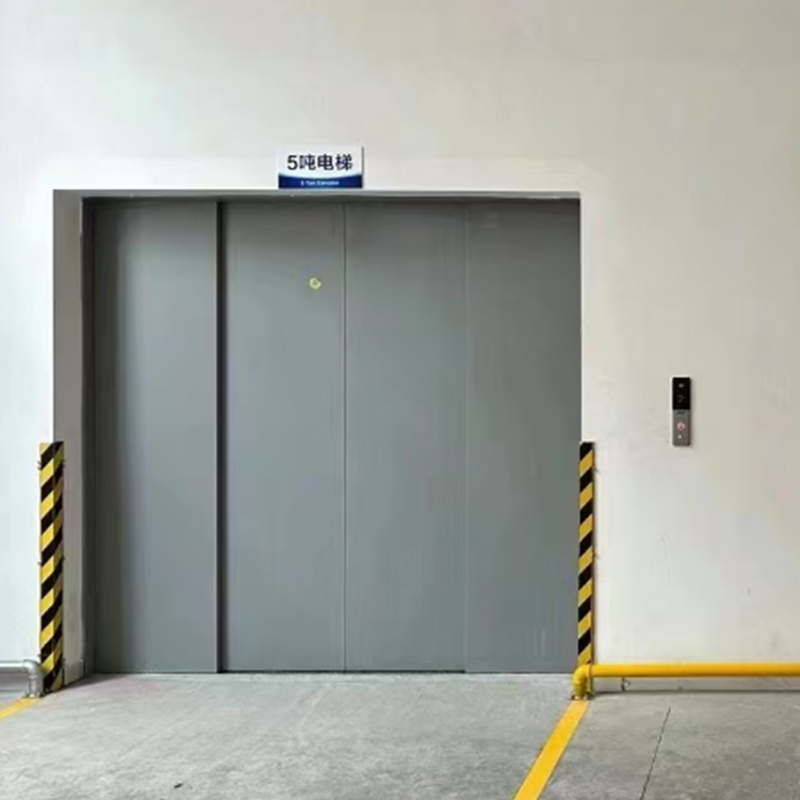 Traction Freight Elevator for Efficient Vertical TransportThis traction freight elevator offers loads from 450 to 2000 kg and speeds up to 7 m/s, with a stainless steel car and LED lighting. It suits facilities needing quick trips and shallow pits for retrofit.View Product →
Key Specifications and Real-World Selection Factors
The three numbers that matter most on a traction freight elevator specification are rated load, car width and clear door opening. Everything else follows from those constraints, including speed, counterweight design and the final installed cost.
In a real project, a logistics manager will usually start with the largest pallet size. Standard pallet dimensions are 1,200 x 1,000 mm, which means a car width of at least 1,500 mm is required for a single-pallet lift. If the facility moves two pallets at once or uses racking, the car width must grow to 2,000 mm or more. The door opening is not the same as the car width: a 1,200 mm door opening gives only about 1,100 mm of clear pass-through space once the frame and guides are subtracted. That 100 mm difference is a frequent cause of damage at the threshold.
- Rated load: always specify 25% above the heaviest single load you actually move.
- Car width: use at least 1,500 mm for standard pallets, 2,000 mm for double pallets.
- Door opening: never assume it equals car width; subtract frame and guide clearances.
- Speed: choose 0.5 m/s for short rises, 1.0 m/s for five floors or more.
- Pit depth: confirm the shaft can accept 400 mm before locking in a gearless design.
Specifying for throughput
For a facility with more than 40 trips per shift, prioritize speed and automatic doors. A traction freight elevator running at 0.5 m/s with a center-opening door can cycle in under 60 seconds. The extra energy cost is modest compared with the labor cost of waiting.
Specifying for retrofit
For a building with a shallow pit or no machine room, the traction MRL route is the only practical answer. Low-pit and low-overhead variants keep the same load capacity while reducing installation disruption.
- Measure the pit depth and overhead clearance inside the shaft.
- Confirm the shaft width and the available door landing width.
- Define the peak load and the number of trips per hour.
- Review the power supply and any machine room space limitations.
- Choose a machine-room-less configuration if routine access is possible from the hoistway.
Installation Constraints for Traction Freight Elevators
Most traction freight elevators can be installed in a retrofit shaft if you plan for low-pit, low-overhead and narrow-shaft conditions. The practical constraints are pit depth, overhead clearance and the width of the hoistway. These three dimensions determine whether a standard traction model will fit or whether the design must be adapted.
Low-pit systems use a compact buffer and reduced counterweight travel, allowing installation with as little as 350 mm of pit depth. Low-overhead solutions keep the drive sheave in the hoistway and use a re-arranged traction sheave position to fit under an existing roof slab. Narrow-shaft models use a central guide rail and a side-mounted counterweight to reduce the required car interior width while maintaining rated load.
These adaptations are not sacrifices. They are standard engineering variants that retain full load capacity and speed. For example, a MRL traction freight elevator can be installed in a shaft only 1,600 mm wide with a 400 mm pit, while still moving a 2,000 kg load at 0.5 m/s. The key is to match the shaft geometry to the drive arrangement before ordering. For custom site conditions, custom design gives you control over the canopy, door frame and cab finish while keeping the traction drive unchanged.
Another critical factor is installation access. If the shaft is landlocked and no frame can be lifted in whole, the traction machine, guide rails and car panels need to be delivered in sections. This is where a manufacturer with in-house assembly experience makes a difference. Our team routinely handles such logistics, and you can read more about traction freight elevator operation stability for evidence of the reliability that follows.
How to Choose the Right Traction Freight Elevator for Your Facility
Selecting the right traction freight elevator starts with a rated load 25% above your heaviest regular load, then works outward to speed, door opening and pit depth. Follow that order and you avoid the typical mistake of buying the least expensive model that fits the shaft, only to find the door opening too small for fork lifts or the speed too low for a two-story warehouse.
The decision tree is straightforward. First, record the heaviest load in kilograms. Second, measure the shaft pit and overhead. Third, list the max trips per hour. Fourth, decide whether a machine room exists. Fifth, choose a manufacturer that can build the exact cab size and can provide the full installation team. The last point deserves attention because a custom traction freight elevator is not an off-the-shelf item. It is an engineered assembly that must be installed, adjusted and tested on site.
If you are working with a manufacturer like Dong'ao Home Elevator, they can handle the full scope from design to after-sales maintenance, including the custom engineering needed for a restricted shaft.
Custom Commercial Freight Elevator ManufacturersManufacturers provide custom traction freight elevators, handling design to after-sales service. Standard models cover 1,000-10,000 kg, with engineered versions for heavier loads, ensuring safety and energy efficiency.View Product →Frequently Asked Questions
What is the load capacity range of traction freight elevators?
Most standard models cover 1,000 kg to 10,000 kg. Heavy-duty custom versions are available for special applications and can be engineered to move 15,000 kg or more when the shaft and structure allow.
Can a traction freight elevator be installed without a machine room?
Yes. A machine-room-less (MRL) traction freight elevator keeps the drive unit and controller inside the hoistway or in a small wall-mounted cabinet. This is a common retrofit solution when no separate machine room can be built.
What maintenance does a traction freight elevator require?
Quarterly checks cover rope tension, sheave wear, door sensor alignment, brake engagement and lubrication of guide rails. Weekly operator checks of the emergency stop and door interlock are also recommended.

-
 Founding Road, Qidu Linhu Economic Zone, Wujiang City, Jiangsu Province, China
-
 [email protected]
-
 +86 15301576876/+86 0512-63818375
QR CODE

