


 En
 English
 русский
 Español
 عربى

Forklift-Proof Flooring and Doors for Traction Freight Elevators: A Guide
Posted by Admin | 23 Nov
Content
- 1 Why Forklift Traffic, Not Rated Load, Sets the Design Brief
- 2 Where Impact Damage Actually Begins
- 3 Reinforced Car Flooring: What "Reinforced" Should Actually Mean
- 4 Doors, Frames, and Door Edges Built for Impact
- 5 Sills, Kick Plates, and Buffers: Small Parts With Large Consequences
- 6 Component-by-Component View of Impact Protection
- 7 A Practical Specification Checklist
- 8 Retrofitting Protection Into an Existing Car
- 9 Frequently Asked Questions
- 9.0.1 Q1: How thick should a freight elevator car floor be for forklift use?
- 9.0.2 Q2: Can existing freight elevator doors be upgraded for impact resistance?
- 9.0.3 Q3: Does reinforcement reduce the elevator's available payload?
- 9.0.4 Q4: What causes most door damage in freight elevators?
- 9.0.5 Q5: How often should flooring and doors be inspected?
A freight elevator car is not simply a passenger cabin with the seats removed. Once forklifts are allowed inside, the car becomes a small enclosed loading bay, and every entry is a slow, tight manoeuvre with several tonnes of machine and load moving through a doorway that was never designed as a collision zone.
In that environment, two components absorb almost all of the punishment: the car floor and the doors. Understanding how each one is reinforced, and where the damage actually begins, is the difference between a car that works for fifteen years and one that is patched every few months.
Why Forklift Traffic, Not Rated Load, Sets the Design Brief
The rated load on a freight elevator nameplate is a static figure. It tells you how much mass the car can hold when that mass is spread reasonably across the platform. It says almost nothing about what happens when a counterbalance forklift rolls in with most of its combined weight carried on the front axle, stops abruptly on the sill, and lowers a pallet that lands slightly off centre.
Three factors drive the real design requirements:
- Point loading. Solid or press-on forklift wheels transfer load through a contact patch of a few square centimetres, so a floor that is adequate for a uniformly distributed load can still deform locally.
- Dynamic amplification. Braking on the sill, dropping a pallet from a small height, and the natural bounce of a loaded mast all produce forces well above the static weight of the load.
- Impact energy. Fork tips, mast channels, and the corners of oversized loads strike doors, frames, and car walls far more often than operators admit.
Duty cycle matters as much as peak load. A car running fully loaded every few minutes places continuous stress on the traction drive system, but the highest short-term stresses still land on the enclosure, which is why flooring and door specification deserves its own line in the procurement document.
Where Impact Damage Actually Begins
Walk into a freight car that has been in service for several years and the wear pattern is remarkably consistent. Damage rarely starts in the middle of the floor or the centre of a door panel. It starts at the boundaries where a moving forklift meets a fixed edge.
- The threshold junction. The gap between the sill and the car floor plate is crossed by every wheel, often at an angle, and is the single most heavily loaded point in the car.
- The sill itself. Fork tips and pallet corners strike the sill when a load is pushed rather than carried.
- The lower door panels. Mast sections and pallet edges make contact while the operator judges clearance.
- The door leading edge and meeting stiles. Repeated small impacts distort the panel profile, after which the doors no longer close squarely.
- The car walls beside the opening. Reversing forklifts and swinging loads mark paint and dent thin panels at carriage height.
- The door track and guide shoes. Debris and slight panel deformation combine to make the door run heavily, which accelerates wear on the hanger and operator.
Each of these locations can be reinforced directly, but the measures are different: the floor needs structural depth and replaceable wear surfaces, while the doors need panel stiffness, controlled closing forces, and protection at exactly the height where impacts occur.
Reinforced Car Flooring: What "Reinforced" Should Actually Mean
A load path, not just a thicker plate
A heavy floor plate bolted onto a light car frame simply moves the problem. Genuine reinforcement means the deck is part of a load path: a steel platform welded or mechanically fixed to a subframe whose cross members are spaced closely enough to keep deflection within acceptable limits under a concentrated wheel load. The specification that matters is the concentrated load rating at a defined contact area, not the uniform load rating alone.
Surface behaviour under wheels and pallets
The working surface has to resist two opposite demands. It must be hard enough not to groove under steel wheels, and tough enough not to crack when a pallet corner lands on it. Checkered or tear-drop plate is common because it combines grip with abrasion resistance, and a slightly raised pattern helps water and dust move away from the contact patch. Coatings that look immaculate on delivery but chip under wheel traffic usually cost more over the life of the car than an unpainted wear surface.
Sacrificial wear plates
The most practical reinforcement detail is also the least glamorous: a separate wear plate laid over the structural deck, fastened so that it can be replaced in sections. The structural floor then keeps its integrity for the life of the elevator, while the surface that actually meets the forklift is treated as a consumable. Where traffic is heavy, wear plates concentrated in the entry zone make even more sense than a single full-area plate.
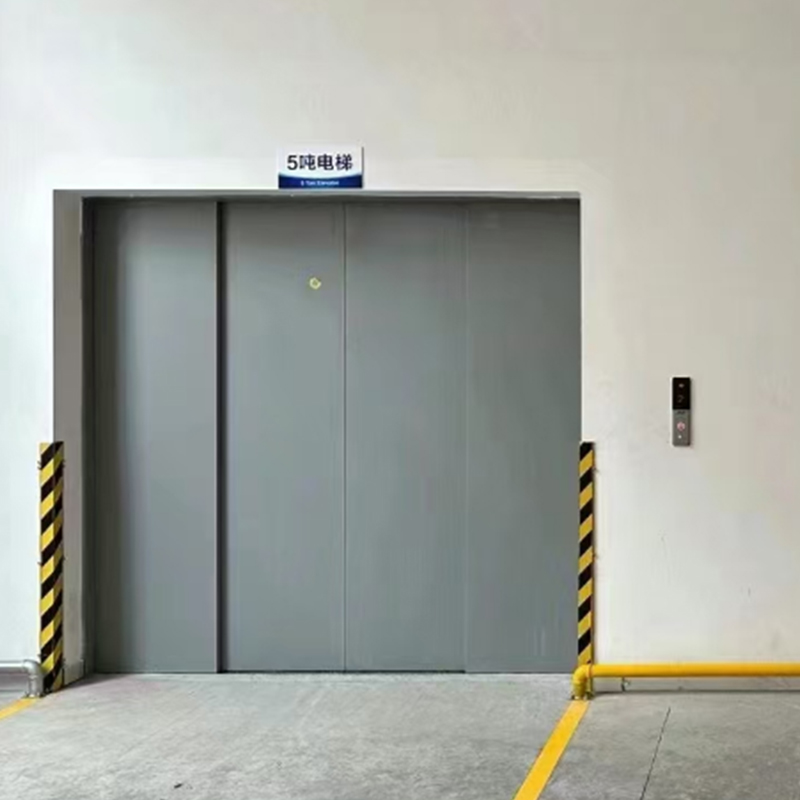 Traction Freight Elevator for Industrial Vertical TransportCustomizable traction freight elevator with 450–2000 kg load range and 1–7 m/s speed, suited to efficient vertical goods transport in commercial and industrial buildings.View Product →
Doors, Frames, and Door Edges Built for Impact
Panel construction and stiffness
Freight door panels are usually double-skin steel with internal ribs or a filled core. The outer skin thickness matters less than the combination of skin thickness, rib spacing, and how the panel is edged. A folded or welded perimeter returns stiffness to the panel face, so a local impact deforms a small area instead of bowing the whole leaf. Panel weight then becomes the next constraint, because heavier leaves demand larger hangers, stronger tracks, and more robust operators.
Vision panels without weak points
Operators need to see into the car, but a glazed aperture is a hole in the strongest part of the door. The usual solution is laminated glass in a reinforced frame, positioned above the height of the tallest fork carriage used on site, with a protective grille or bar arrangement in front of it. Glass set at carriage height will eventually be struck, and replacing laminated panels is far more expensive than replacing a grille bar.
Door control as an impact measure
Half of all door damage is caused by the door itself, not the forklift. A door that closes quickly on a slow-moving load, or that reverses only after significant contact, will be pushed out of alignment repeatedly. Light curtains or multiple photocells across the full opening height, a sensitive reopening device, reduced closing speed in the final section, and mechanical bumpers on the leading edges all reduce the energy that reaches the panel.
Traction Freight Elevator with Safety and Energy-Saving FeaturesCommercial cargo elevator using traction drive, with anti-fall safety devices, multiple safety circuits, variable frequency control, and gearless permanent magnet synchronous main engine for transport.View Product →Sills, Kick Plates, and Buffers: Small Parts With Large Consequences
The sill is the most abused component in any freight elevator. A robust detail usually includes a heavy section rather than a folded sheet, a chamfered or ramped entry so wheels roll across instead of striking an edge, and an insert that can be renewed without dismantling the door track. Because the sill carries the gap between car and landing, its geometry directly affects ride quality and noise as well as durability.
Kick plates protect the lower car walls where pallet corners and reversing forklifts make contact. A practical height is one that covers the range from floor level to roughly the top of a loaded pallet side, and bolt-on plates are preferable to welded ones because they can be replaced after a bad day. Rubber or polymer bumpers set at carriage height, together with protected corner posts, absorb the impacts that would otherwise be transferred into the car frame.
Component-by-Component View of Impact Protection
| Component | Typical impact source | Reinforcement approach |
|---|---|---|
| Car floor deck | Forklift wheels, dropped pallets | Closely spaced subframe plus replaceable wear plate |
| Sill and threshold | Wheel crossing, fork tip contact | Heavy sill section, ramped entry, renewable insert |
| Door panels | Mast, pallet edges, load corners | Double-skin steel, internal ribs, reinforced lower zone |
| Vision panel | Fork tips, long loads | Laminated glass above carriage height with grille |
| Track and guides | Skewed entry, door bounce | Reinforced guide shoes, debris-clearing track profile |
| Kick plate and walls | Pallet sides, reversing forklifts | Bolt-on plates and bumpers at carriage height |
A Practical Specification Checklist
- Describe the handling equipment honestly: forklift type, wheel type, loaded axle weight, and the longest load carried.
- Ask for the concentrated load rating of the floor at a stated contact area, not only the uniform rated load.
- Confirm whether the deck includes a sacrificial wear plate and how it is fastened.
- Review door panel gauge, internal reinforcement, and hanger capacity together, since heavier panels change the door system.
- Check that vision panels sit above the tallest fork carriage in use.
- Inspect the sill detail and confirm it can be replaced without removing the door track.
- Verify that bumper and kick plate heights match the actual equipment, not a generic drawing.
- Confirm reopening device and light curtain coverage across the full door height.
- Ask for spare part lead times on panels, sills, and wear plates before the car enters service.
Retrofitting Protection Into an Existing Car
Not every reinforcement decision happens at the factory. Many freight cars are upgraded in service, either because the traffic changed from pallet trucks to forklifts or because repeated repairs became uneconomical. In those cases the sequence matters: establish the floor's real capacity first, then address the door system, then add the cheap sacrificial parts. Adding heavy wear plates to a floor with inadequate subframe spacing simply transfers the deformation to the subframe.
Where site conditions, shaft dimensions, or door opening geometry do not match a standard configuration, a custom design approach allows the flooring build-up, door stiffening, and bumper positions to be matched to the actual equipment on site rather than to an average assumption. Retrofit work rarely changes the elevator's rated load in a favourable direction, because added steel increases car weight and has to be reconciled with the counterweight and the drive duty, so the design should be reviewed as a system rather than a list of parts.
Frequently Asked Questions
Q1: How thick should a freight elevator car floor be for forklift use?
There is no single figure that works for every car. Thickness only helps when it is matched to subframe spacing and the actual wheel loads. A thinner deck over closely spaced members can outperform a thick plate spanning wide gaps, so the specification should state a concentrated load at a defined contact area.
Q2: Can existing freight elevator doors be upgraded for impact resistance?
Yes, in most cases. Typical measures include reinforcing the lower panels, fitting protective grilles over vision panels, adding leading-edge bumpers, and improving the reopening device and light curtain coverage. Very light original panels sometimes justify full replacement instead.
Q3: Does reinforcement reduce the elevator's available payload?
It can. Wear plates, heavier panels, and bumpers add car weight, which affects the balance of the system and may reduce the useful payload unless the counterweight and drive are reviewed. This is why reinforcement should be designed together with the elevator rather than added afterwards.
Q4: What causes most door damage in freight elevators?
Angled entry and premature door closing. Operators misjudge clearance while concentrating on the load, and doors that close quickly or reverse late convert a small nudge into a bent panel. Better door control usually prevents more damage than thicker steel.
Q5: How often should flooring and doors be inspected?
Inspection intervals should follow traffic intensity rather than the calendar alone. A visual check of the sill, wear plate fastenings, door leading edges, and guide shoes at each scheduled service, with a closer examination of floor deflection in heavily used cars, catches most problems before they become repairs.

-
 Founding Road, Qidu Linhu Economic Zone, Wujiang City, Jiangsu Province, China
-
 [email protected]
-
 +86 15301576876/+86 0512-63818375
QR CODE

