En
En English
 русский
 Español
 عربى
عربى
Defining the Traction Platform Elevator
A traction platform elevator is a type of vertical transportation system that uses a motor-driven sheave (pulley) and steel ropes or belts to move the car. Unlike hydraulic elevators, which rely on a piston and fluid, traction elevators operate using friction between the ropes and the sheave. This mechanical arrangement makes them more energy-efficient, especially in taller buildings, and enables faster travel speeds.
In residential and light-commercial settings, the traction platform elevator has become increasingly popular as a modern alternative to traditional hydraulic lifts. It typically requires less maintenance, avoids the environmental risks of hydraulic fluid, and provides a smoother ride quality.
Core Mechanical Principle
The core principle behind a traction elevator is the counterweight system. The car is attached to one end of a steel rope, and a counterweight is attached to the other. The rope loops over a drive sheave at the top. When the motor rotates the sheave, friction moves the ropes, lifting the car while the counterweight descends, and vice versa. This arrangement balances the load, reducing the motor power needed to move the car by up to 60% compared to older technologies.
Figure 1: Schematic of a traction platform elevator system showing the car, counterweight, and drive sheave arrangement.
Key Components of a Traction Platform Elevator
A traction platform elevator consists of several essential mechanical and electrical systems working together. Understanding these components is critical for proper specification and maintenance.
Drive System
The drive system comprises an electric motor and a traction sheave. Two main configurations exist:
- Geared traction: Uses a gearbox between the motor and sheave, suitable for speeds up to 0.4 m/s in residential applications.
- Gearless traction: Directly connects the motor to the sheave, enabling higher speeds and greater energy efficiency, often using permanent magnet synchronous motors that can save over 60% energy compared to older systems.
Suspension System
Steel ropes or polyurethane-coated steel belts connect the car to the counterweight. The number of ropes depends on the rated load capacity. Most residential traction elevators use 4 to 6 ropes, each designed to support the full load independently as a safety measure.
Counterweight Assembly
The counterweight balances the weight of the car plus a standard passenger load (typically 40-50% of rated capacity). This reduces the motor work and improves energy consumption. The counterweight travels on its own set of guide rails, separate from the car rails.
Safety Devices
Modern traction platform elevators incorporate numerous safety mechanisms including:
- Overspeed governors that activate mechanical brakes if the car exceeds its rated speed
- Safety gears mounted on the car frame that grip the guide rails in an emergency
- Buffers in the pit to absorb energy in case of over-travel
- Door interlocks that prevent opening when the car is not at the landing
- Battery-operated emergency lowering systems for power failure scenarios
Control System
Modern controls use VVVF (Variable Voltage Variable Frequency) drives for smooth acceleration and deceleration. Microprocessor-based controllers manage floor positioning, door operations, and safety monitoring. Many platforms now include touchscreen interfaces and smartphone connectivity as standard features.
Types of Traction Platform Elevators
Traction platform elevators are available in several configurations to suit different building types and installation constraints.
| Configuration | Key Features | Best Application |
|---|---|---|
| Machine Room (MR) | Motor and controller in separate room; easier maintenance access; longer travel distances | Buildings with available space above or beside shaft |
| Machine Room-Less (MRL) | All components within the hoistway; no extra space needed; compact footprint | Retrofits, homes, and space-constrained buildings |
| Cabinless Platform | Open design with handrails; panoramic glazing; minimal pit depth (as low as 5cm) | Modern residential interiors with aesthetic focus |
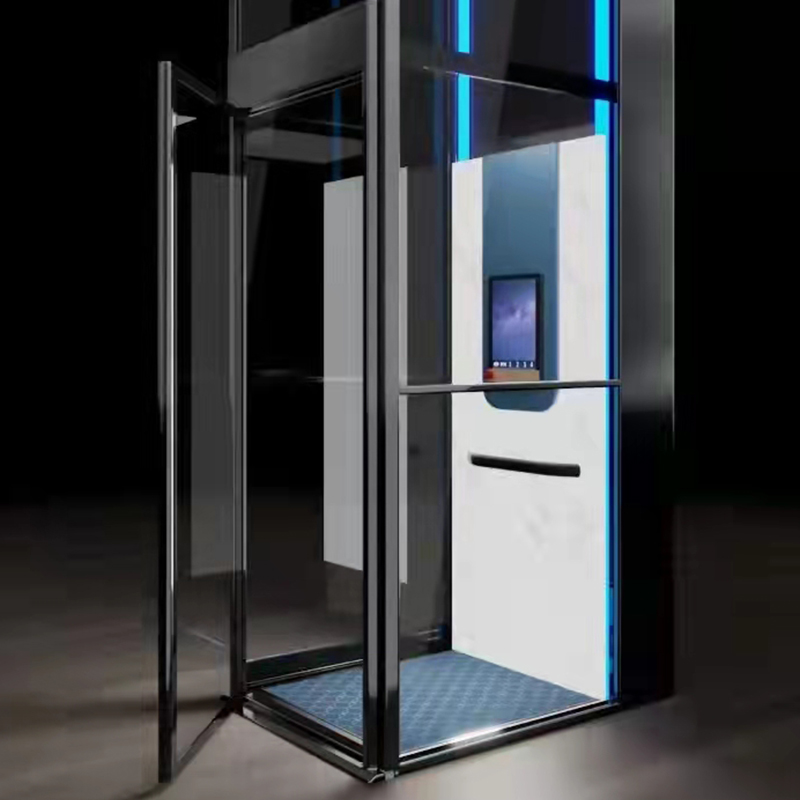
The cabinless or platform-only design has gained popularity in luxury residential projects because it maximizes usable space and creates a visually open experience. These models often feature sensitive-edge safety systems and illuminated handrails that activate the lift by touch.
Performance Specifications
Understanding the performance parameters of a traction platform elevator is essential when planning an installation.
Speed Range
0.15 - 0.4 m/s
Residential models
Load Capacity
400 - 500 kg
Residential (up to 6 persons)
Max Travel Height
14 - 20 m
Up to 6 floors
Pit Depth
50 - 150 mm
Minimum for some models
For residential traction platform elevators, the most common specification is 400 kg capacity (5-6 persons) with a speed of 0.15 to 0.4 m/s. While this speed is lower than commercial elevators, it is appropriate for home use and prioritizes passenger comfort and safety.
Overhead height requirements vary significantly by configuration. Machine room-less designs typically need less overhead clearance, making them suitable for buildings with limited top space.
Traction vs. Hydraulic: A Practical Comparison
The choice between traction and hydraulic elevators is one of the most common decision points for architects and building owners. The following comparison highlights the key differentiators.
| Characteristic | Traction Platform Elevator | Hydraulic Elevator |
|---|---|---|
| Energy Efficiency | High (counterweight reduces motor load) | Lower (pump works against gravity) |
| Travel Height | Nearly unlimited | Limited (typically 3-5 floors) |
| Environmental Impact | No oil; lower carbon footprint | Oil fluid; leak risk |
| Ride Quality | Smoother, quieter | Can be jerky; mechanical valve noise |
| Installation Cost | Higher initial equipment cost | Lower initial cost |
| Space Efficiency | MRL options reduce space needs | Requires piston and machine room |
While hydraulic elevators have a lower initial purchase price, traction elevators typically offer better long-term value through reduced energy consumption and lower maintenance requirements. For buildings with more than two stories, the energy savings of a traction system can offset the higher upfront cost within a few years of operation.
Advantages and Limitations
Based on industry specifications and manufacturer data, the traction platform elevator presents a distinct set of advantages and limitations that should inform any decision-making process.
Advantages
Energy Efficiency
Counterweight system reduces power consumption by up to 60% compared to hydraulic units
Smooth Ride Quality
Gradual acceleration and deceleration provide superior passenger comfort
Environmental Safety
No hydraulic fluid eliminates contamination risk
Higher Travel Capacity
Can serve buildings with many floors without performance degradation
Limitations
- Higher Initial Investment: Traction systems typically cost more to purchase and install than comparable hydraulic units.
- Space Requirements: Some configurations need a machine room or additional overhead space, though MRL designs address this constraint.
- Complex Installation: The counterweight and guide rail system requires precise alignment and more technical skill to install correctly.
- Rope Maintenance: Steel ropes require periodic inspection and eventual replacement, typically every 10-15 years depending on usage.
Installation Considerations
When planning to install a traction platform elevator, several physical and regulatory factors require careful evaluation.
Space Requirements
For a typical residential traction elevator, the minimum clear hoistway dimensions range from 1800 mm x 1800 mm for smaller capacities (450 kg) to 2600 mm x 2400 mm for larger capacities (1600 kg). The platform size varies from approximately 900 mm x 800 mm up to 1100 mm x 1400 mm depending on the model and capacity.
Machine room-less models can eliminate the separate equipment room, but still require adequate overhead space for the machine and controls. The top level height (overhead) for a typical home installation should be at least 2850 mm, with pit depths of 150 mm or more. Some modern cabinless designs have reduced the minimum pit to as little as 50 mm, greatly simplifying installation in existing buildings.
Structural Requirements
The elevator loads must be supported by the building structure, including the guide rail brackets, machine support beams, and pit floor. The guide rails, typically attached to the shaft walls, must be aligned vertically within tight tolerances to ensure smooth operation. The machine support structure, especially for geared traction systems, must be designed to handle the dynamic loads from motor operation.
Regulatory Compliance
Most jurisdictions require traction platform elevators to meet specific safety standards. In Europe, the EN 81-41 standard applies to platform lifts, while in the US, the ASME A17.1 code governs elevator installations. Key requirements include:
- Control button height accessibility
- Emergency lighting and communication systems
- Door zone detection to prevent opening outside the landing area
- Overload protection and no-start systems
- Battery backup for emergency lowering and door opening
Cost and Maintenance Factors
Understanding the total cost of ownership is critical when evaluating a traction platform elevator investment.
Initial Cost Components
The purchase price for a traction platform elevator typically ranges significantly based on configuration, capacity, and finish quality. For residential units, prices can range from approximately $10,000 to $25,000 or more depending on customization. Key cost drivers include:
- Load capacity and speed rating
- Number of stops (floors)
- Door configuration and materials
- Interior finishes (cabin wall panels, flooring, ceiling)
- Control system features (touchscreen, app integration, remote monitoring)
Ongoing Costs
Maintenance for traction elevators is generally predictable and lower than hydraulic systems because there is no hydraulic fluid to change or maintain. Routine maintenance should be performed every 3-6 months and typically includes:
- Rope inspection for wear and proper tension
- Guide rail lubrication and alignment check
- Brake system inspection and adjustment
- Electrical contact cleaning and software updates
- Door operator and interlock testing
Emergency repair costs can be higher if the sheave or motor requires replacement, but these components typically have a long service life. Properly maintained traction elevators often exceed 20 years of reliable service.
Frequently Asked Questions
Q1: What is a traction platform elevator?
A traction platform elevator is a vertical lift that uses a motor-driven sheave and rope system with a counterweight to move the car. It operates on friction between the ropes and sheave, offering energy efficiency and smooth ride quality for residential and light-commercial buildings.
Q2: How does a traction elevator differ from a hydraulic elevator?
Traction elevators use ropes, a counterweight, and a sheave driven by an electric motor. Hydraulic elevators use a piston and fluid pump. Traction models are more energy-efficient, handle taller buildings, and have no oil-related environmental risks, while hydraulic units are typically less expensive initially and suited for lower buildings.
Q3: What is the minimum pit depth required for a traction platform elevator?
The required pit depth varies by model. Standard residential traction elevators may need 150 mm or more, while some modern cabinless designs can operate with a pit as shallow as 50 mm. Always verify with the manufacturer specifications for your chosen model.
Q4: Can a traction platform elevator be installed without a machine room?
Yes, machine room-less (MRL) traction elevators are available. These designs place all mechanical and control components within the hoistway or above the car, eliminating the need for a separate equipment room. This makes them ideal for retrofits and space-constrained buildings.
Q5: What is the typical speed for a residential traction elevator?
Residential traction platform elevators typically operate at speeds between 0.15 m/s and 0.4 m/s. This speed is designed for passenger comfort and safety within the travel distances typical of homes.
Q6: How long do traction elevator ropes last?
Steel ropes on traction elevators typically last 10 to 15 years depending on usage, maintenance, and environmental conditions. Regular inspection is required to identify wear before it becomes a safety concern.
Q7: Is a traction elevator suitable for a two-story home?
Yes, traction elevators are suitable for two-story homes. Despite their association with high-rise buildings, traction technology works well for low-rise residential applications and provides better energy efficiency and ride quality than hydraulic alternatives, even for just two floors.
Q8: What safety features are standard on traction platform elevators?
Standard safety features include overspeed governors, safety gears, door interlocks, battery backup for emergency lowering, overload protection, and buffers in the pit. Many modern models also include sensitive-edge systems and automatic fault detection.